Why Latin-to-Script Convert Needs Its Own Small Model
Transliteration is not translation or general writing. See why UnimeType separates Convert from cloud-based Polish and Explain actions.
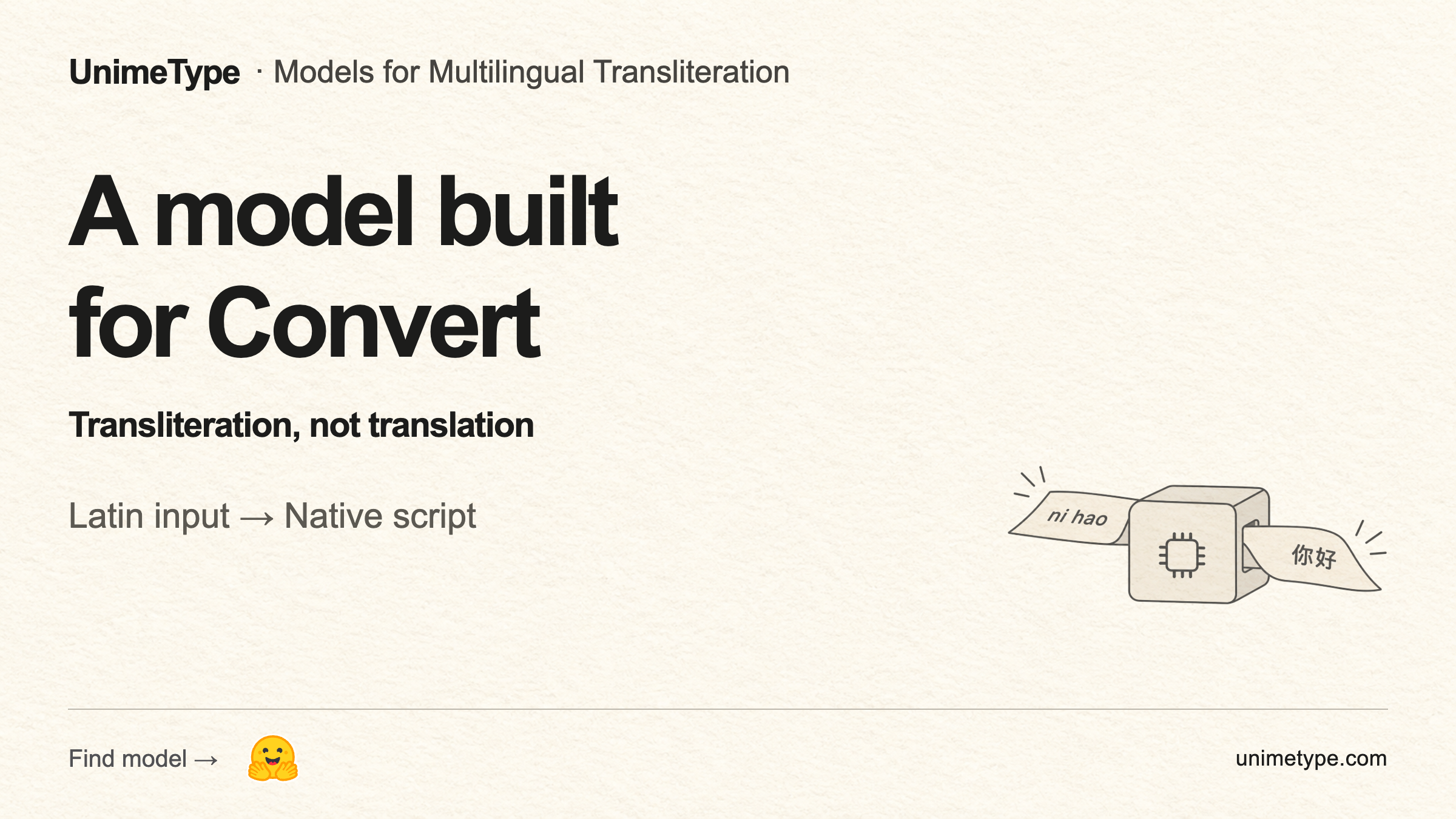
You type aaj meeting hai, but you want आज meeting है. The meaning should stay put. The English word should stay in English. Only the Latin-written Hindi should move into Devanagari. That small example is the reason Convert deserves a model of its own.
This is part one of our Transliteration Model Series: the practical decisions behind UnimeType Transliteration-4B.
Convert is a bounded text operation
Convert changes the writing system of text that is already composed. It is not asked to improve the tone, add an explanation, summarize a paragraph, or invent a reply.
For example:
ashita Tokyo de meeting ga arimasu
明日 Tokyo で meeting があります
The useful output preserves Tokyo and meeting, converts the Japanese reading, and returns only the replacement text. More fluent prose is not automatically a better answer if it changes that contract.
Polish and Explain need different capabilities
Polish may rewrite wording and sentence structure. Explain may need broad knowledge and a longer answer. Those actions benefit from a capable cloud model because their output space is open-ended.
Convert has a narrower target. A small local model can be trained to follow a short set of rules repeatedly:
- convert only the intended Latin-written phrase;
- preserve English, code, links, handles, numbers, and emoji;
- preserve line breaks and punctuation;
- return replacement text without commentary.
Separating the actions also makes failure easier to measure. If a Convert result changes a URL or translates an English product name, the output is wrong even when the sentence still sounds natural.
A specialist model can spend its capacity on the hard boundary
The difficult part is not merely producing Chinese, Japanese, Arabic, or Devanagari characters. The model must decide which spans belong to the target language and which spans must remain untouched.
Consider:
qing yunxing npm test ranhou debug OpenAI API
A useful converter needs to transform the Chinese reading while preserving the command and product name. That boundary appears constantly in messages, issue trackers, study notes, and social posts.
A general chat model can perform the task, but it also carries capabilities Convert does not need. A specialist model lets training examples, evaluation cases, and runtime settings focus on the one operation users actually trigger.
The product boundary is simple
UnimeType Transliteration-4B is for Convert. Polish and Explain remain separate cloud actions. Choosing a local model for Convert does not mean forcing every writing feature into the same model.
The next article explains how we build everyday transliteration data without treating translation corpora as typing data. The exact behavior of each product action is listed in Actions.
Choose your platformSee the current download and testing options.
View downloadsNext: How to type Hindi using an English keyboard: 3 methods