Pinyin, Romaji, Hinglish, and Arabizi Are Not the Same Task
Chinese, Japanese, Hindi, and Arabic start from Latin letters, but ambiguity, code-switching, dialect, and target scripts differ sharply.
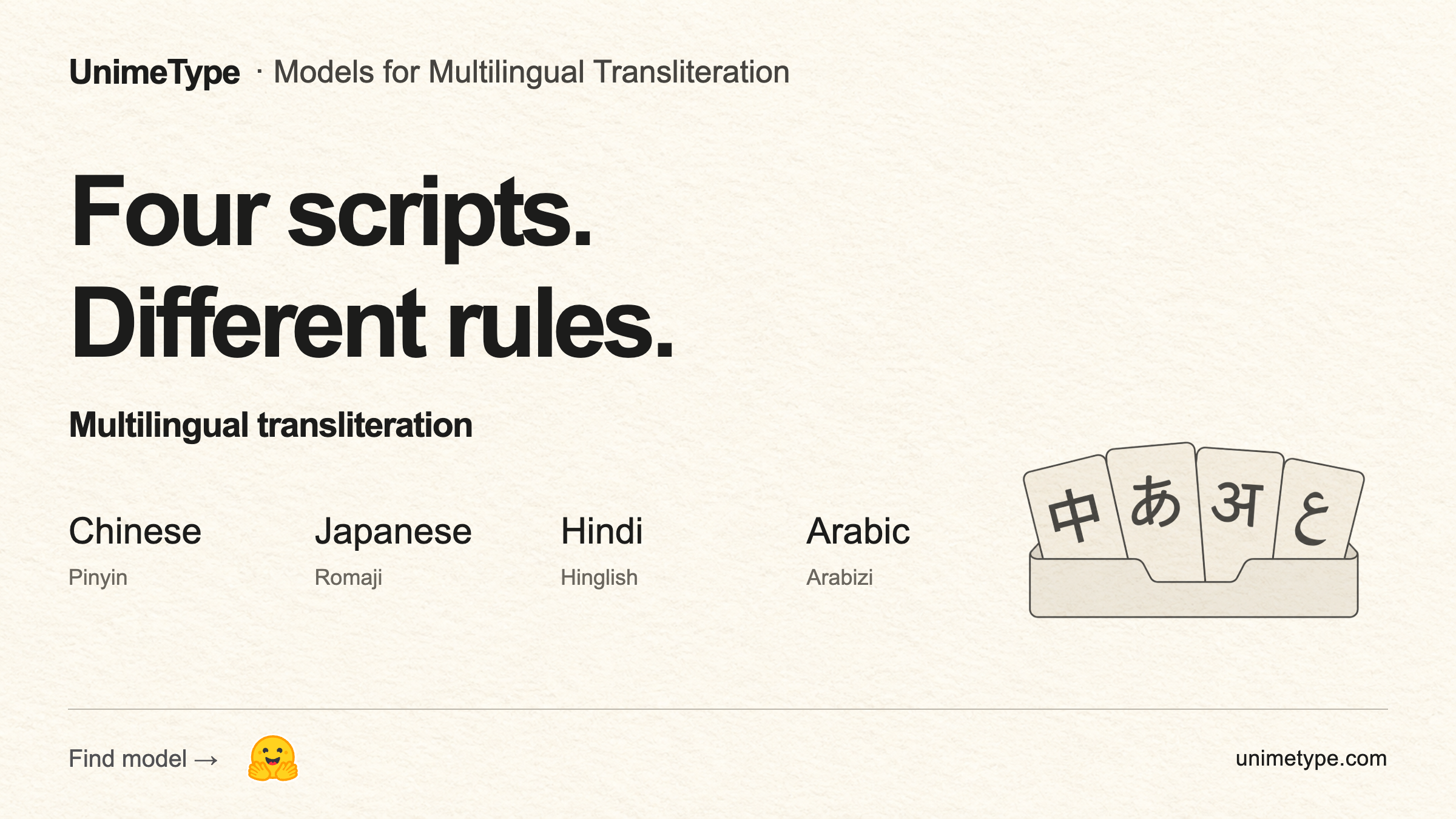
Pinyin, Romaji, Hinglish, and Arabizi all put non-Latin languages into Latin characters. That visual similarity is misleading. A multilingual Convert model faces a different decision process for each one.
Pinyin is short and highly ambiguous
Without tones, a short form such as shi can point to many Chinese characters. Context decides whether the intended result concerns time, a person, a fact, or something else. Longer phrases reduce ambiguity, but mixed English creates another boundary: mingtian sync yixia should not turn sync into Chinese.
Romaji crosses several Japanese writing systems
Japanese output may require kanji, hiragana, katakana, or a mixture. The model is not only mapping sounds to symbols; it is selecting conventional word forms and particles from context. Names and English technical terms can also be intentionally left in Latin characters.
Hinglish is code-switching, not one fixed romanization standard
Many Hindi messages mix English and Hindi naturally. The same Hindi sound can be spelled several ways in Latin letters, and the user may want only the Hindi spans in Devanagari. The preservation decision is central, not an afterthought.
Arabizi adds dialect and chat numerals
Arabic written in Latin characters varies by region and community. Digits such as 2, 3, and 7 may represent Arabic sounds, while the surrounding vocabulary can be dialectal. Short vowels are often omitted, and several valid Arabic spellings may express the same casual message.
This makes strict exact match especially demanding: a model can produce understandable Arabic and still differ from the expected spelling. A useful evaluation must record both exact replacement behavior and the kinds of disagreement that remain.
One model still needs four language-specific test slices
A total score can hide a weak language. We therefore keep separate Chinese, Japanese, Hindi, and Arabic counts. We also inspect protected English, names, code, links, punctuation, multiline text, and already-converted controls.
The next article asks whether this task needs 1B, 2B, 4B, or 27B parameters. Supported input behavior is described in Input languages.
Choose your platformSee the current download and testing options.
View downloadsNext: How to type Hindi using an English keyboard: 3 methods