Everyday bilingual messages: keep English as the base
Write mostly in English, keep the second-language phrase you actually need, and avoid switching keyboards for every short phrase.
I’ll be home around 七点, can you start dinner first?
This is a bilingual message, but it is not split evenly between two languages. English carries the grammar. The Chinese time phrase supplies one detail.
Many everyday messages work this way. A second language appears where it says the time, place, name, or feeling better than the surrounding sentence does.
Let one language carry the sentence
Keeping a clear base language makes a mixed message easier to draft and review. The second-language phrase can stay short:
- I left my umbrella 在你车里, can you bring it tomorrow?
- The package should arrive mañana, so I’ll text you when it comes.
- I’ll send the photos 明日 after dinner.
- I’m already on the bus, but 我会晚一点.
These messages do not need to become fully bilingual documents. Each one uses another language for a specific piece of information.
The interruption is often the keyboard state
With separate input sources, one short phrase can require you to switch keyboards, enter and confirm the phrase, switch back, and check the active layout before continuing. The message is easy; keeping track of the input source is the fiddly part.
If you know the phrase in a Latin spelling, you can finish the draft without changing layouts:
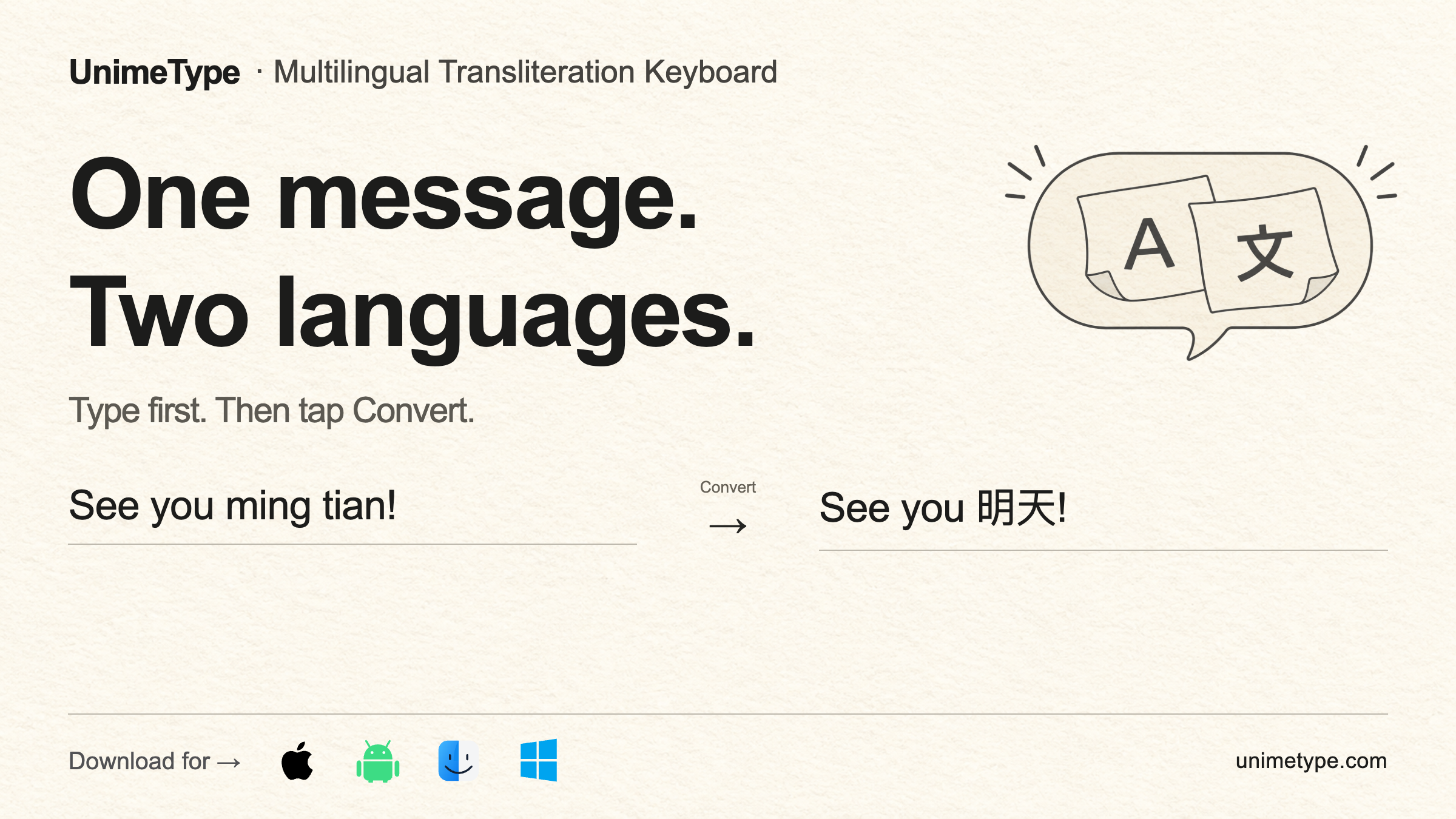
Draft Can we meet ming tian xia wu after class?
After conversion Can we meet 明天下午 after class?
In UnimeType, Convert runs only when you choose it. You decide when the draft is ready and which text should be processed. English words should remain English, but the complete result still needs a quick read before sending.
The same approach also works for short requests and family messages:
Are you free 周六 morning for coffee?
Can you bring the 蓝色 bag when you come?
I’ll call after dinner, 你先休息.
Read the whole message once
After conversion, check that names, links, numbers, and the English sentence frame are unchanged. Do not process passwords, recovery phrases, or private information you are not allowed to share.
If most of the next paragraph will be Chinese, Japanese, Spanish, or another language, switch to the system input method instead. The multilingual typing guide separates these two cases, while Input languages documents the languages available in UnimeType.
When the task is rewriting an existing message rather than converting its script, see AI keyboard Polish writing.
Choose your platformSee the current download and testing options.
View downloadsNext: AI keyboard or ChatGPT? Choose based on where your message lives